
Precision lost-wax and die casting components in aluminium, zinc, brass and special alloys. Complex geometries, tight tolerances and superior surface finish — from prototype to mass production.
Investment die casting is an advanced metal-forming technology that combines the geometric freedom of investment (lost-wax) casting with the speed and repeatability of die casting. The result: highly precise, near-net-shape components with excellent surface finish and minimal post-processing — ideal for complex parts that other processes simply cannot produce economically.
In investment casting, a wax pattern of the finished part is coated in layers of ceramic slurry to build a refractory shell mould. The wax is melted out, molten metal is poured in, and once solidified the ceramic shell is broken away to reveal a component that faithfully reproduces every detail of the original wax pattern. In pressure die casting, molten metal is injected into a hardened steel die under high pressure for extremely fast, high-volume production.
At Audhe Industries, we deploy both techniques — and guide you to the right process based on your part geometry, volume, material, tolerance and cost targets. With over 15 years of precision casting experience from our Coimbatore facility, we deliver investment die cast components to automotive, aerospace, medical, defence and industrial clients across 30+ countries.
±0.1 mm on critical dimensions — often no secondary machining required
Ra 1.6–3.2 µm as-cast — ready for painting, anodising or plating
Undercuts, thin walls, internal channels — impossible for conventional casting
Aluminium, zinc, brass, stainless steel and special alloys on request
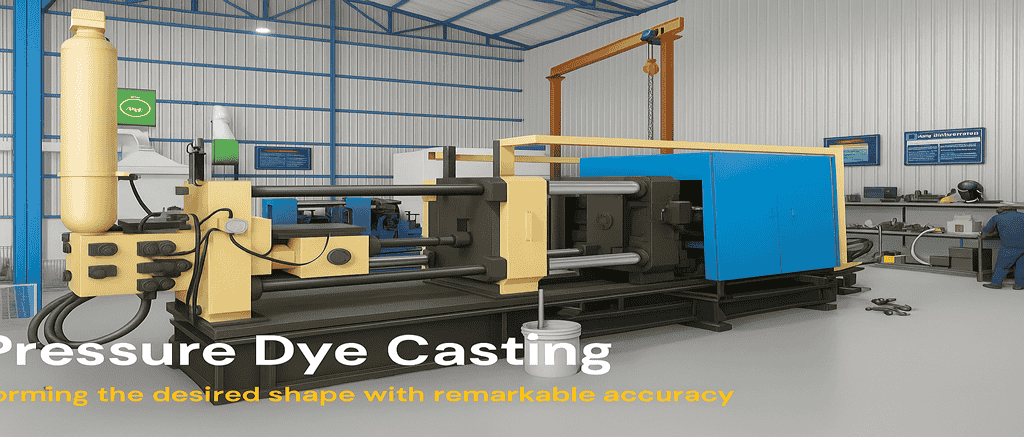
Choosing the wrong casting process costs money. Here is an honest comparison to help you and our team pick the right method for your part.
Not sure which process is right for you? Send us your drawing and our engineers will recommend the optimal process with a free quote.
From your drawing to a verified, packed shipment — here is how every investment die casting project flows through our Coimbatore facility.
We review your 2D/3D drawings and perform Design for Manufacturability (DFM) analysis — recommending parting lines, wall thickness, draft angles and gating strategy to optimise quality and cost.
For investment casting: wax injection dies are precision-machined in our tool room. For pressure die casting: hardened H13 steel dies with cooling channels are manufactured and polished to the required cavity finish.
Investment casting: wax patterns are injected, assembled into a tree, coated in ceramic slurry, dewaxed at high temperature, and metal is poured. Die casting: molten alloy is injected into the die at 10–175 MPa for rapid, precise filling.
Shell knockout, shot blasting and fettling for investment castings. Trimming, deburring and CNC machining of critical bores, threads and datum surfaces where required. Post-treatments: T5/T6 heat treatment, painting, anodising, plating available in-house or via approved sub-contractors.
100% visual inspection, CMM dimensional verification, spectrometer chemistry check, and pressure/leak testing where applicable. First-article reports and PPAP documentation available on request.
Export-standard packing with individual part protection. Full traceability labels, COC, material test reports and packing list shipped with every consignment. FOB Chennai / CIF worldwide.
New parts undergo a first-article inspection (FAI) against your drawing before production approval. We provide a dimensional report and sample for your sign-off — ensuring zero surprises in production.
Your dedicated account manager keeps you updated at every production stage — from tooling progress to shipping tracking. Regular supplier reports and proactive communication as standard.
The investment casting process is fascinating in its precision. Here is exactly how we transform a wax pattern into a flawless precision component at our Coimbatore foundry.

The investment casting process begins with a wax replica of your finished part. Our tool room manufactures precision aluminium injection dies into which wax is injected under controlled temperature and pressure to produce patterns that accurately replicate even fine surface detail.
The quality of the wax pattern directly determines the quality of the final casting — our pattern makers treat this stage with the care of a precision machining operation.

Once the wax tree is assembled, it is dipped repeatedly in refractory ceramic slurry and coated with stucco (refractory sand) between dips. Each layer is allowed to dry before the next is applied. Building a shell typically involves 6–12 dip-dry cycles over several hours or days:
The ceramic shell must be strong enough to withstand the thermal shock of molten metal at 700–1650 °C yet brittle enough to be knocked away cleanly after solidification.

The completed ceramic-coated wax tree is placed into a flash de-wax autoclave. Steam at 165 °C and 6 bar pressure melts the wax within minutes, which drains out cleanly and is reclaimed for reuse. The hollow ceramic shell is then placed in a high-temperature furnace (900–1100 °C) to:
The pre-heated mould is immediately transferred to the pouring station where molten metal — verified by spectrometer analysis — is poured. Gravity, vacuum or centrifugal pouring methods are selected based on alloy and part complexity. Solidification is controlled to achieve the target microstructure and mechanical properties.

After controlled cooling, the ceramic shell is vibrated, hammered or mechanically broken away to reveal the casting tree. Individual castings are then cut from the sprue by band saw or grinding wheel. The remaining process steps prepare the casting for delivery:
We work across a broad range of casting alloys. Our metallurgy team helps you select the optimal material based on mechanical requirements, corrosion resistance, weight targets and cost.
Lightweight, excellent thermal conductivity and corrosion resistance. The most widely used die casting material for automotive, aerospace and consumer product applications.
Exceptional dimensional accuracy, excellent surface finish for decorative and functional parts. Higher density but lower cost tooling and faster cycle times than aluminium.
Superior corrosion resistance, attractive finish and good machinability. Ideal for plumbing fittings, valve bodies, electrical connectors and decorative hardware via investment casting.
Investment casting excels with high-melting-point materials including stainless steel, tool steel and nickel-based superalloys for high-temperature and corrosion-critical applications.
Use this reference to check whether your part falls within our standard capability range. Custom requirements outside these parameters are welcome — contact us to discuss.
| Parameter | Investment Casting | Pressure Die Casting | Notes |
|---|---|---|---|
| Part Weight Range | 5 g – 50 kg | 10 g – 25 kg | Consult us for parts outside this range |
| Dimensional Tolerance | ±0.1 mm (critical) | ±0.05 mm (critical) | Per ISO 8062 / NADCA standards |
| Surface Roughness (as-cast) | Ra 1.6 – 3.2 µm | Ra 0.8 – 1.6 µm | Better than sand or gravity die casting |
| Minimum Wall Thickness | 1.5 mm | 0.8 mm (Al) / 0.5 mm (Zn) | Geometry-dependent |
| Typical Batch Size | 50 – 500,000 pcs | 1,000 – 1,000,000+ pcs | Small prototype batches also available |
| Materials | Al, Zn, Brass, SS, Inconel | Al alloys, Zinc alloys | Custom alloys on request |
| Tooling Lead Time | 3 – 5 weeks | 4 – 8 weeks | Depends on complexity |
| Production Lead Time | 2 – 4 weeks | 1 – 3 weeks (after approval) | From purchase order to dispatch |
| Post-Casting Machining | Available in-house | Available in-house | CNC turning, milling, drilling, threading |
| Surface Treatments | Painting, anodising, plating | Painting, powder coat, chromate | Via approved sub-contractors |
All specifications are indicative and depend on part geometry, alloy and process parameters. Contact us with your drawing for a precise assessment.
Our precision investment and die cast components are trusted in the most demanding industrial and commercial applications worldwide.
Gearbox housings, engine brackets, fuel system components, EV motor housings, sensor bodies
Lightweight structural brackets, actuator housings, weapon components, avionics enclosures
Surgical instrument handles, imaging equipment frames, prosthetic components, sterilisable parts
Impellers, valve bodies, manifold blocks, pump end covers, flanges for hydraulic systems
Heat sinks, connector housings, RF shielding enclosures, antenna brackets, PCB mounting frames
Gearbox end caps, bearing housings, conveyor components, precision locking mechanisms
Irrigation fittings, tractor brackets, sprayer nozzle bodies, harvesting machine components
Door hardware, luxury fittings, sporting equipment components, lighting fixtures, trophy parts
Investment die casting demands zero compromise on quality — the process is used precisely because conventional methods cannot meet the specification. Our quality system is built to match that expectation.
Co-ordinate measuring machine inspection on first articles and statistical sampling in production. Every critical dimension reported against drawing.
Every heat verified by optical emission spectrometer before pouring — chemistry deviations stopped at the source, never shipped.
Dye penetrant (PT) inspection for surface cracks. X-ray or ultrasonic testing available for critical, pressure-retaining investment castings.
COC, material test reports, dimensional inspection report, PPAP and packing list provided with every shipment — standard, not optional.
Precision casting is a partnership — the right supplier directly affects your part quality, tooling cost, delivery reliability and total cost of ownership.
Our internal tool room designs and manufactures wax injection dies and pressure die casting dies — reducing new-part lead times, lowering tooling cost and giving you a single accountable supplier for the complete supply chain.
Before any tooling is committed, our engineers perform Design for Manufacturability review and mould flow / solidification simulation — catching potential defects digitally rather than in metal, saving time and cost.
Castings requiring precision machined bores, threads, or datum surfaces are finished in our on-site CNC machine shop. One vendor, one quality record, one delivery — no coordination headache between casting and machining suppliers.
The near-net-shape nature of investment casting reduces material waste, lowers machining time and decreases total part cost — particularly for complex geometries that would require extensive CNC work from billet.
We routinely export to clients in the USA, UK, Germany, UAE and beyond. Certificate of Origin, commercial invoice, packing list, COC, material test reports and PPAP are handled seamlessly by our export team.
You are assigned a dedicated account manager who speaks your technical language. From first enquiry through production and shipment, one person owns your project and keeps you proactively informed.
Have a question not covered here? Call +91 422 417 2126 or email enquiry@audhe.com — our technical team responds within 24 hours.
Upload your drawing or describe your requirement. Our engineers will respond within 24 hours with a process recommendation, DFM feedback and competitive quote.