
Custom stamping dies, progressive dies, press tools, injection mold tools, jigs and fixtures — designed in-house with CAD/CAM and manufactured to micron precision using CNC and EDM machining.
Tool and die making is the skilled craft of designing, manufacturing and maintaining the precision tools, dies, molds, jigs and fixtures that shape every metal and plastic component in modern manufacturing. Without high-quality tooling, there is no consistent, scalable, cost-effective production.
At Audhe Industries, our in-house tool room is the backbone of our entire manufacturing capability. When we produce aluminium castings, iron castings, investment die castings or CNC machined components, the tooling that makes it all possible is designed and built right here — by our own engineers and toolmakers — at our Coimbatore facility.
With over 15 years of toolroom experience, CAD/CAM design capability, CNC milling, turning, Wire EDM and Sinker EDM machining, we deliver custom stamping dies, progressive dies, casting dies, press tools, injection mold tools, jigs and fixtures for clients across India and in 30+ countries globally. Our tooling is built to last, engineered to tight tolerances, and designed to reduce your per-part production cost over the long run.
SolidWorks, AutoCAD, Mastercam — full 3D design and simulation before machining begins
±5 µm accuracy on CNC mills, lathes, Wire EDM and Sinker EDM
D2, A2, H13, HSS and carbide — heat treated and TiN coated for long tool life
Ongoing tool sharpening, refurbishment and preventive maintenance to extend tool life

From simple blanking dies to complex multi-stage progressive tooling, our tool room handles the full spectrum of die and tool types required by modern manufacturing.
Sheet metal stamping dies for cutting, blanking, piercing, trimming and notching operations. Built from D2 or carbide for high-volume, long-life production runs.
Multi-station progressive dies that perform multiple operations (blank, pierce, form, draw, trim) in a single press stroke — ideal for complex sheet metal parts in high volume.
Precision bending dies, V-dies, U-channel dies and compound forming tools that shape sheet metal without removing material. Springback compensation designed in from the start.
Draw dies for forming cup, can, housing and shell shapes from flat sheet. Blank holder force, draw radius and punch-die clearance are precisely engineered to avoid wrinkling and tearing.
Gravity die casting, pressure die casting and low-pressure die casting tooling. In-house H13 steel dies with cooling channels, ejector systems and gate/runner design for our own casting production.
Two-plate and three-plate injection mold tools for engineering-grade plastics. Core and cavity inserts machined to mirror finish. Hot runner, cold runner and side gate configurations available.
Drill jigs, welding fixtures, assembly fixtures and inspection gauges that locate, support and guide workpieces for consistent, repeatable machining and assembly operations.
Transfer dies move parts station-to-station for complex sequences. Compound dies perform blanking and piercing simultaneously in a single press stroke for maximum productivity.
Aluminium wax injection dies for our investment casting process. Precision-machined cavities reproduce fine surface detail in the wax pattern, which determines the accuracy of the final cast component.
Every tool or die we build follows a structured, quality-gated process to ensure it performs exactly to specification from day one of production.
Engineers review your part drawing and perform Design for Manufacturability (DFM) analysis. We recommend optimal die type, strip layout, parting lines, draft angles and gating before any steel is cut.
Full 3D CAD models of the tool are created in SolidWorks. CAM programming (Mastercam, Fusion 360) generates CNC tool paths. Simulation verifies tool motion and material flow before machining.
Tool steel grade is selected based on part material, production volume and required tool life. D2, A2, H13, HSS or carbide is procured from certified suppliers with material certificates included.
CNC machining centres rough-machine the die block to near-net form, leaving grinding and EDM stock. CNC lathes turn round punch shanks and guide posts to intermediate sizes ready for hardening.
Tool components are hardened and tempered by certified heat treatment to achieve the target hardness (HRC 58–62 for D2, HRC 54–58 for H13). Hardness is verified on receipt by Rockwell testing.
Surface grinding and cylindrical grinding brings all mating surfaces to final size and flatness. Surface roughness is measured and verified — typically Ra 0.4–0.8 µm on die faces and Ra 0.1–0.2 µm on polished cavity surfaces.
Wire EDM cuts intricate profiles, sharp corners and complex contours in hardened steel with ±3 µm accuracy — impossible by conventional milling. Sinker EDM creates detailed cavities, ribs and textured surfaces in mold inserts and die blocks.
Skilled toolmakers hand-fit and assemble punch and die sets, guide pillars, guide bushings, springs, ejectors and stripper plates. Clearances are checked and adjusted to spec before the first trial.
The assembled tool is trialled on the press or moulding machine. First-off parts are dimensionally inspected against drawing. Adjustments are made — shimming, fitting, polishing — until all dimensions and surface finish meet spec.
Approved tooling is handed over with a complete tooling record card, drawing set and maintenance schedule. Our tool room provides ongoing sharpening, repair and refurbishment to maximise tool life and production uptime.
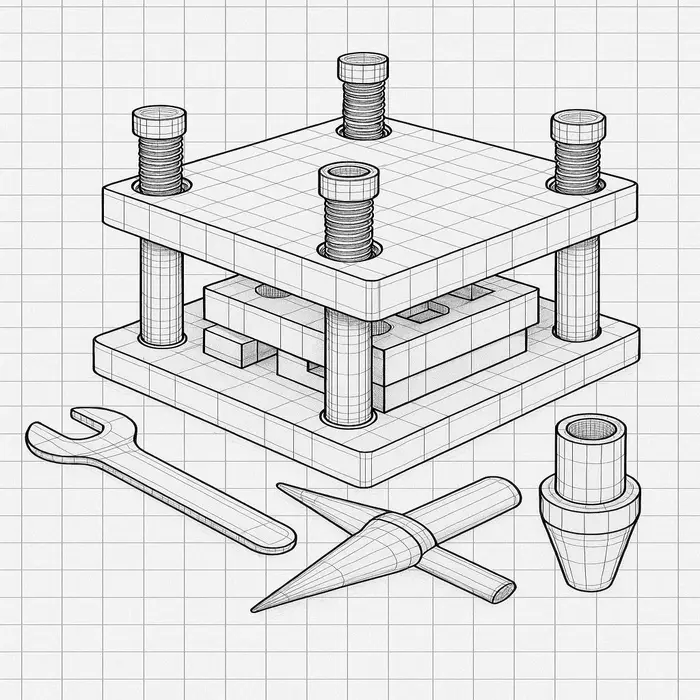
The accuracy of a die is determined long before any metal is cut. Our tool designers use SolidWorks for full parametric 3D modelling of die sets, including punch, die, stripper plate, backing plate, guide pillars and die shoe. Every component is modelled with exact tolerances, fits and clearances.
All designs are reviewed and approved by a senior tool engineer before the work order is released to the machine shop.
Our tool room is equipped to machine the most demanding die steel with the precision required for consistent production tooling:

The material and heat treatment of a tool or die determine its service life, wear resistance and performance under production stresses. We select and specify materials precisely for each application:
Our tool room is equipped with the precision machinery and software needed to design and manufacture any tool or die our clients require.
3-axis and 4-axis vertical machining centres for milling die blocks, cavities and complex profiles in pre-hardened and annealed tool steel.
CNC wire-cut EDM with ±3 µm accuracy for intricate profiles, punch blanks, die inserts and micro features in any hardness of tool steel or carbide.
Ram EDM for burning cavities, ribs and lettering into mold inserts. Graphite and copper electrodes precision-machined on our CNC mills.
Surface grinders for flatness and parallelism to 2 µm. Cylindrical grinders for punch and pillar diameters to tolerance bands of ±0.002 mm.
CNC turning for guide pillars, punch shanks, ejector pins and round die inserts with diametral tolerances to h5/H5 fit classes.
SolidWorks for 3D modelling and assembly simulation. Mastercam and Fusion 360 for CNC programming. AutoCAD for 2D die layout and detail drawings.
Coordinate Measuring Machine verification of completed tool components. All critical dimensions reported against drawing before assembly.
Rockwell hardness tester verifies heat treatment. Optical comparators, height gauges and precision bore gauges complete the inspection suite.
Choosing the right tool steel grade directly affects tool life, maintenance cost and total cost per part. Use this guide to understand which material we recommend for your application.
| Material | Grade | Hardness (HRC) | Key Properties | Best For |
|---|---|---|---|---|
| D2 Tool Steel | AISI D2 / IS T215Cr12 | 58–62 | High wear resistance, dimensional stability, moderate toughness | Long-run blanking dies, progressive dies, drawing dies |
| A2 Tool Steel | AISI A2 | 57–61 | Air-hardened, low distortion, good toughness | Forming dies, bending dies, moderate-run stamping |
| H13 Hot Work Steel | AISI H13 / DIN 1.2344 | 44–52 | Excellent thermal fatigue resistance, good toughness at elevated temp. | Al die casting dies, hot forming tools, extrusion |
| M2 High-Speed Steel | AISI M2 | 62–65 | Outstanding edge retention, high red hardness | Cutting punches, fine blanking, high-speed stamping |
| P20 Pre-hardened Steel | AISI P20 | 28–34 | Good machinability in pre-hardened state, no further HT needed | Plastic injection mold frames, large housings |
| Tungsten Carbide (WC-Co) | K10 / K20 | 90–92 HRA | Extreme wear resistance and hardness, brittle | Carbide punch inserts, wire drawing dies, ultra-high volume |
| TiN PVD Coating | PVD TiN | ~80 HRC equiv. | Reduces friction by 30%, extends tool life 3–5× | Applied to D2, H13 and M2 tools for longer service life |
Our engineers will specify the optimal material and heat treatment for your die based on part material, thickness, batch size and required tool life. Contact us with your drawing for a recommendation.
Our tool room supplies precision tooling to manufacturers across a broad range of industries — each with unique material, tolerance and production-volume requirements.
Body panel dies, door inner stamping dies, bracket progressive dies, automotive plastic mold tools
Forming dies for titanium/Inconel panels, aircraft bracket tooling, precision jigs for sub-assembly
Micro-blanking dies for PCB shields, connector stamping dies, enclosure mold tools for consumer electronics
High-precision tooling for surgical instrument stampings, implant components and device enclosures — ISO 13485 aligned
Casting dies for pump body, impeller and valve components — designed and maintained by our in-house toolroom
Progressive dies for textile machine components, bracket stampings and spring-form tools for loom parts
Tooling for kitchen appliances, hardware fittings, lighting components and household product stampings
Custom jigs, fixtures, gauges and special tooling for machine shops, assembly lines and sub-contract manufacturers
The quality of a tool or die determines the quality of every part it ever produces. We apply the same rigour to tooling inspection as we do to our production components — zero compromises.
All critical tool component dimensions are verified on our CMM before assembly. Reports issued against drawing with GD&T callouts.
Rockwell hardness verified on every hardened component after heat treatment — confirms the material achieved target HRC before grinding begins.
Trial parts from new tooling are dimensionally inspected against the component drawing — the tool is only approved when parts meet specification.
Each tool carries a tool card recording material certificates, heat treatment records, dimensions, trial results and all subsequent maintenance activities — full traceability for the life of the tool.
The tool and die industry is evolving rapidly. At Audhe Industries, we invest in these technologies to deliver better tooling, faster, at lower total cost.
AI-driven DFM analysis and tool path optimisation reduces machining time, extends cutter life and improves surface finish — delivering better tooling faster at lower cost.
Virtual simulation of tool performance before any steel is cut — predicting wear patterns, identifying potential failure points and optimising maintenance intervals.
Additive manufacturing of conformal-cooled inserts for injection molds and prototype tooling — dramatically reducing cycle times and enabling geometries impossible with conventional machining.
Next-generation DLC (Diamond-Like Carbon) and nanocomposite coatings extending tool life by 5–10× in demanding materials like AHSS and stainless steel stampings.
Your tooling supplier is a long-term strategic partner — the quality and reliability of your tooling determines your production quality for years. Here is why clients trust us.
Our tool room is not a standalone business — it is the engine behind our casting and machining operations. Tooling and production are managed under one quality system, one team and one roof, giving you a level of integration that standalone tool shops cannot match.
From your drawing to a validated first-off part — our engineers design, program, machine and trial the tool entirely in-house. No outsourcing, no handoff delays, no finger-pointing between vendors. Single-point accountability from concept to production.
Most competitors outsource Wire EDM. We run our own Wire EDM machines in-house — giving us the ability to cut complex profiles in hardened D2 and carbide with ±3 µm accuracy without external lead times or quality risk.
We design tooling for long life and low maintenance — right material selection, correct heat treatment, appropriate coatings and conservative design margins. A tool that runs for 2 million strokes without major rework costs less over its life than a cheap tool that fails at 200,000.
We regularly ship tooling to clients in the USA, UK, Germany, UAE and beyond. Export-packed, dimensionally verified, with full tooling documentation. Indian precision tooling at globally competitive cost.
We maintain the tools we build. Regrinding worn punches, replacing cracked die inserts, adjusting clearances and refurbishing worn tooling are all part of our aftercare service — keeping your production running and your tooling investment protected.
Have a question not covered here? Call +91 422 417 2126 or email enquiry@audhe.com — our engineering team will respond within 24 hours.
Send us your part drawing or describe your tooling requirement. Our tool engineers will respond within 24 hours with a DFM recommendation, process plan and competitive quote.