
Table of Contents

Aluminium for Casting
Aluminium for casting is at the core of what we do at Audhe Industries. This technique entails guiding molten aluminium into moulds, shaping it into a diverse range of high-precision components for automotive, aerospace, construction, marine and consumer electronics industries.
One of the most striking attributes of aluminium for casting is its strength-to-weight ratio. It is possible to produce components that are simultaneously light and strong — particularly suited for the transportation industries that prioritise fuel economy and performance. The natural corrosion resistance of aluminium means products require minimal maintenance, as aluminium forms a protective oxide layer that prevents rust without any coating.
The versatility of aluminium for casting allows for the production of an exceptionally wide range of products. Audhe Industries follows an environmentally friendly process — aluminium moulds and castings are highly recyclable, and the long-term benefits include savings on lifecycle costs and energy efficiency. Aluminium for casting has never been a compromise between function and sustainability.
1Types of Aluminium Alloys for Casting
Aluminium alloys are classified into wrought alloys (for forming and machining) and cast alloys (optimised for casting processes). The most common casting alloy series each offer distinct property profiles suited to different applications.
Aluminium-Silicon Alloys (Series 4xx)
The most widely used casting alloys — excellent fluidity, outstanding resistance to thermal expansion and good corrosion resistance. Die casting and permanent mould casting both use these alloys extensively. Their castability makes them ideal for intricate designs and thin-walled components in automotive and aerospace applications.
Aluminium-Copper Alloys (Series 2xx)
High strength and excellent machinability make these alloys preferred for aerospace applications where maximum mechanical performance is the priority. The trade-off is lower corrosion resistance compared to silicon-based alloys — often requiring surface protection for outdoor or marine environments.
Aluminium-Zinc Alloys (Series 7xx)
Among the highest-strength aluminium casting alloys available — aerospace and military applications are their primary domain. Excellent weldability but more susceptible to stress corrosion cracking than other series, requiring careful design to avoid sustained tensile stresses in corrosive environments.
Aluminium-Magnesium Alloys (Series 5xx)
Good corrosion resistance — particularly in marine and industrial environments where exposure to moisture and salt is a concern. Excellent weldability and a moderate strength-to-weight ratio make these alloys well-suited for pressure vessels, marine components and structural applications.
Aluminium-Lithium Alloys (Series 8xx)
Advanced aerospace applications use these alloys for their exceptional combination of lightweight and high strength — lithium additions reduce density by approximately 10% while maintaining excellent specific stiffness. They enable structural weight reduction without sacrificing load-bearing performance in aircraft and spacecraft.
2Casting Processes for Aluminium
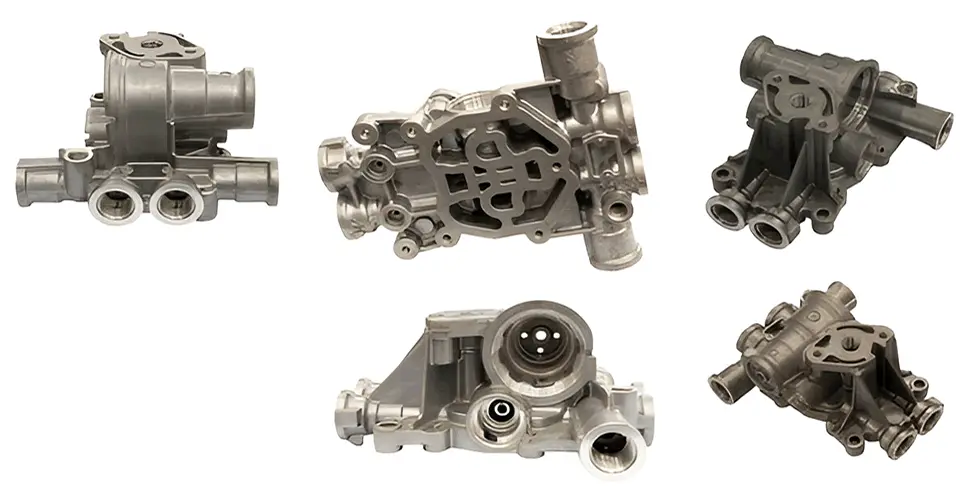
Aluminium's castability — its ability to fill moulds completely and replicate fine details — makes it compatible with a wider range of casting processes than most other structural metals. Each process offers different trade-offs in cost, volume suitability, complexity and surface finish.
Sand Casting
Creates a mould from a compacted sand mixture around a pattern. Highly versatile and cost-effective for low to medium volumes. Ideal for large and intricate components — but produces a rougher surface finish than die casting. Widest range of part sizes and shapes.
Die Casting (HPDC)
Molten aluminium injected into a hardened steel die under high pressure. Produces precise, smooth parts with tight dimensional tolerances at very high production rates. The preferred process for automotive and electronics volume production. Requires higher tooling investment.
Investment Casting (Lost Wax)
A wax pattern is coated in ceramic shell — once fired, the wax melts away leaving a precision mould. Produces very high dimensional accuracy and exceptional surface finish for complex, small-to-medium parts. Used extensively in aerospace, medical and precision engineering.
Permanent Mould Casting
Reusable metal moulds (steel or cast iron) improve heat transfer and surface finish compared to sand casting. Better mechanical properties from faster solidification. Most suitable for medium production volumes of simpler shapes. Lower per-part cost than sand casting at volume.
Shell Moulding
A thin shell of sand and phenolic resin is formed around a heated metal pattern. Provides better dimensional accuracy and surface finish than conventional sand moulding. Suitable for medium-volume production where HPDC tooling investment is not justified. Good for smaller structural parts.
Gravity Die Casting
Molten aluminium poured into permanent metal moulds using gravity — no applied pressure. Produces denser castings with lower porosity than HPDC for thicker-walled structural parts. Lower tooling cost than HPDC. Widely used for automotive structural components, cylinder heads and wheels.
3Advantages of Aluminium for Casting
Lightweight
Aluminium is significantly lighter than steel (~2.7 g/cm³ vs ~7.8 g/cm³) — ideal for automotive and aerospace applications where weight reduction directly improves fuel efficiency, payload capacity and performance.
High Strength-to-Weight Ratio
Offers excellent structural strength while remaining lightweight — enabling components that are both strong enough for demanding structural roles and light enough to contribute to system-level weight savings.
Corrosion Resistance
Aluminium naturally forms a dense, self-healing aluminium oxide layer that prevents further corrosion — reducing maintenance costs and extending component lifespan, especially in outdoor, marine and chemical environments.
Excellent Castability
Aluminium has outstanding fluidity when molten — filling complex moulds, thin walls and intricate features with excellent detail reproduction. This enables a wide range of complex designs that would be impossible in less castable metals.
Good Thermal and Electrical Conductivity
Thermal conductivity of approximately 150–200 W/m·K makes aluminium ideal for heat sinks, heat exchangers and thermal management components. Electrical conductivity enables use in power distribution and electronics housings.
Recyclability
Aluminium is 100% recyclable without loss of properties across unlimited recycling cycles. Secondary (recycled) aluminium requires only 5% of the energy needed to produce primary aluminium from bauxite — making it one of the most environmentally friendly structural metals available.
Cost-Effectiveness
While initial tooling costs may be higher than some alternatives, the long-term durability, low maintenance requirements, recyclability and manufacturing efficiency of aluminium castings lead to lower total lifecycle costs across the product's operational lifespan.
4Applications of Aluminium Castings by Industry
Automotive
Engine blocks, cylinder heads, transmission housings, wheels, brackets and EV battery enclosures. Lightweight aluminium castings improve fuel efficiency and vehicle performance — and are central to the shift to electric vehicles where reducing unsprung and total vehicle mass is critical.
Aerospace
Aircraft frames, engine components, landing gear parts and structural brackets. The high strength-to-weight ratio of aluminium casting alloys directly enhances flight performance, payload capacity and structural integrity — while meeting stringent certification requirements.
Consumer Goods and Electronics
Electronics housings, laptop chassis, smartphone frames, appliance bodies and heat sinks. Aluminium's combination of durability, thermal conductivity, dimensional precision and aesthetic appeal makes it ideal for consumer product enclosures and structural components.
Construction
Window frames, curtain walling, door hardware, structural connectors and architectural components. Aluminium's corrosion resistance ensures long-lasting, low-maintenance building components that retain structural performance and appearance over decades.
Marine
Engine parts, propeller hubs, fittings, structural brackets and offshore equipment components. The marine environment is among the most corrosion-challenging — aluminium's natural resistance to salt water makes it essential for marine applications where steel would require constant protection.
Industrial Equipment
Pump housings, compressor bodies, valve bodies, gearbox housings and heavy machinery components. The lightweight yet strong nature of aluminium castings improves operational efficiency, reduces equipment weight and lowers energy consumption in industrial machinery applications.
5Challenges in Aluminium Casting
Porosity
Gas trapped in the molten aluminium creates voids (porosity) in the solidified casting — weakening the part and causing quality failures. To address this, moulds must be properly vented, metal temperature carefully controlled, melt quality maintained through degassing, and injection speed optimised to avoid turbulent fill that entraps air.
Shrinkage and Voids
Aluminium contracts approximately 4–7% as it solidifies — the liquid metal feeding the casting can fail to compensate, leaving internal voids or surface sinks. Solutions include strategically designing moulds with risers (feeding reservoirs), using directional solidification techniques and optimising cooling channel placement to control solidification sequence.
Surface Defects and Inclusions
Granular surface features or non-metallic inclusions can stem from external impurities (oxides, slag), poorly maintained moulds or inadequate melt treatment. The most effective prevention is to keep all materials and tools clean, filter the melt before pouring, maintain mould coating quality and handle molten metal with minimal turbulence.
Mould Wear and Tool Life
Repeated thermal cycling of the mould between the high temperature of molten aluminium (~700°C) and ambient conditions causes thermal fatigue — leading to heat checking (surface cracking) that progressively worsens. Regular inspection, timely maintenance and correct H13 tool steel selection with appropriate heat treatment are essential for achieving economic die life.
6Best Practices for Aluminium Casting
Optimise Mould Design
Design moulds for optimal metal flow and controlled cooling. Incorporate risers and gates sized to ensure adequate feeding. Use simulation software to predict filling and solidification before tooling is cut — preventing expensive defects from reaching production.
Control Pouring Temperature
Maintain the correct pouring temperature for the specific aluminium alloy being cast. Too high causes gas pick-up and increased shrinkage; too low causes cold shuts and incomplete fill. Consistent temperature control is the single most impactful process variable for casting quality.
Enhance Mould Venting
Proper venting allows gases displaced by the incoming metal to escape efficiently. Inadequate venting is one of the most common causes of porosity defects. Vent placement and sizing must be part of the initial mould design — retrofitting vents is difficult and expensive.
Use Quality Materials
Select high-quality aluminium alloys with tight chemistry specifications. Use clean charge materials and apply melt treatment (degassing, flux) before pouring. Contaminated metal is the root cause of oxide inclusions, porosity and inconsistent mechanical properties in the final casting.
Regular Mould Maintenance
Inspect mould surfaces after each production run for heat checking, wear and coating degradation. Address early-stage cracking before it propagates and affects part quality. A well-maintained mould produces consistently superior parts and achieves far greater economic life than one that is run to failure.
Implement Quality Control
Establish rigorous in-process and final inspection protocols — dimensional measurement, visual inspection, and non-destructive testing (X-ray for internal porosity, dye penetrant for surface cracks) where specifications require it. Early defect detection prevents scrap and customer returns.
Train Operators Continuously
Skilled operators make the difference between marginal and excellent casting quality. Provide ongoing training on alloy metallurgy, process parameters, mould handling and defect identification. Knowledgeable operators recognise early warning signs and intervene before defects reach finished parts.
7Future Trends in Aluminium Casting
3D Printing and Additive Manufacturing
Advances in 3D printing enable creation of complex sand moulds and investment casting patterns — dramatically reducing lead times and costs for prototype tooling. Allows rapid design iteration before committing to production tooling investment, and enables moulds with internal cooling channels impossible to machine conventionally.
Smart Manufacturing and IoT
Integration of IoT sensors and real-time data analytics allows continuous monitoring of moulding process parameters — temperature, pressure, fill time, die temperature — enabling immediate correction of drift before defects occur. AI-powered quality prediction identifies process conditions associated with scrap before parts are cast.
Advanced Alloy Development
Researchers are developing new aluminium casting alloys with enhanced properties — improved high-temperature strength for EV powertrains, better ductility for structural gigacastings, and self-healing surface characteristics. New Al-Mg-Sc alloys and nano-reinforced composites are active development frontiers.
Robotics and Automation
Robotic cells for ladling, die spraying, part extraction, trimming and in-line inspection are replacing manual operations — enhancing precision, reducing human error, improving safety and enabling consistent 24-hour production. Collaborative robots (cobots) are bringing automation within reach of smaller casting operations.
Simulation Software
Advanced mould flow simulation tools (Magmasoft, FLOW-3D, AnyCasting) model the complete casting process — predicting fill patterns, porosity risk zones, solidification fronts and thermal stress. Simulation-guided mould design reduces first-tool tryout iterations and speeds new product launches significantly.
Sustainable Casting Practices
Innovations in green sand reclamation, low-emission binder systems, energy-efficient melting furnaces and closed-loop cooling water systems are reducing the environmental footprint of aluminium casting operations. Increased use of recycled aluminium feedstock further reduces energy consumption and carbon emissions per tonne of cast product.
Heat Treatment Innovations
New heat treatment cycles — including high-temperature and short-time ageing variants — enhance mechanical properties of cast aluminium while reducing process energy and cycle time. Tailored heat treatment enables more precise control of strength, ductility and fatigue life for specific applications.
8Environmental Impact of Aluminium Casting
The increasing importance of sustainability has made aluminium for casting one of the most environmentally responsible choices in manufacturing. Several characteristics combine to make aluminium casting a genuinely green manufacturing process when operated responsibly.
- 100% recyclability without property degradation: Aluminium can be melted and recast indefinitely without any loss of its mechanical, chemical or physical properties. This is unique among structural metals and underpins the circular economy case for aluminium
- 95% energy saving in recycling: Producing secondary (recycled) aluminium requires only approximately 5% of the energy needed to produce primary aluminium from bauxite ore through the Bayer and Hall-Héroult processes. This dramatic energy saving translates directly to a lower carbon footprint per tonne of cast product
- High recycling rate in practice: Aluminium from manufacturing scrap (gates, runners, rejected castings) is returned to the furnace in the same production shift — achieving near-100% in-house recycling with zero material loss. End-of-life product recycling rates for aluminium are among the highest of any manufactured material
- Lightweight vehicles reduce lifetime emissions: Aluminium castings in automotive and aerospace applications reduce vehicle weight — each kilogram saved in a vehicle reduces lifetime CO₂ emissions significantly through improved fuel economy or extended electric range. The environmental benefit of lightweight aluminium components over the vehicle's lifetime far exceeds the energy invested in their production
- Improving manufacturing sustainability: Energy-efficient furnace technology, optimised process control reducing scrap rates, closed-loop cooling water systems and renewable energy adoption in aluminium smelting are all driving further reductions in the industry's environmental footprint
Conclusion
Many industries favour aluminium in their casting processes for good reason — its light weight combined with high strength, exceptional corrosion resistance, outstanding castability and full recyclability create a unique combination that no other common structural metal matches comprehensively.
With increasing focus on sustainable development, employing aluminium for casting makes both environmental and economic sense. The continuing evolution of casting alloys, processes and manufacturing technologies means that aluminium casting's capabilities and cost-effectiveness are expanding, not contracting. At Audhe Industries, aluminium for casting remains central to our mission of delivering precision, performance and sustainability to our customers across every sector we serve.
Related Articles


