
Table of Contents
- 1. What is 5-Axis CNC Machining?
- 2. How 5-Axis CNC Machines Work
- 3. Types of 5-Axis CNC Machines
- 4. Materials Used
- 5. Key Advantages
- 6. Applications and Industries
- 7. 3-Axis vs 5-Axis Comparison
- 8. When Does 5-Axis Make Sense?
- 9. Tight Tolerances
- 10. Limitations and Challenges
- 11. Choosing the Right Service Provider
- FAQ

5-Axis CNC Machining Services
5-axis CNC machining services help engineers and manufacturers produce complex and precise parts by moving a cutting tool or workpiece along five axes simultaneously. This enables the creation of curved surfaces, angled features and intricate geometries — in materials ranging from aluminium and titanium to plastics and composites — within a single setup.
Unlike 3-axis CNC machines which move only in X, Y and Z directions, a 5-axis machine can tilt, rotate and approach the part from multiple angles. This allows manufacturers to create complex shapes and curved surfaces in one setup — improving accuracy, efficiency and surface finish significantly.
5-axis CNC machining is the preferred process in aerospace, medical, automotive and industrial manufacturing where high precision and tight tolerances are non-negotiable.
1How 5-Axis CNC Machines Work
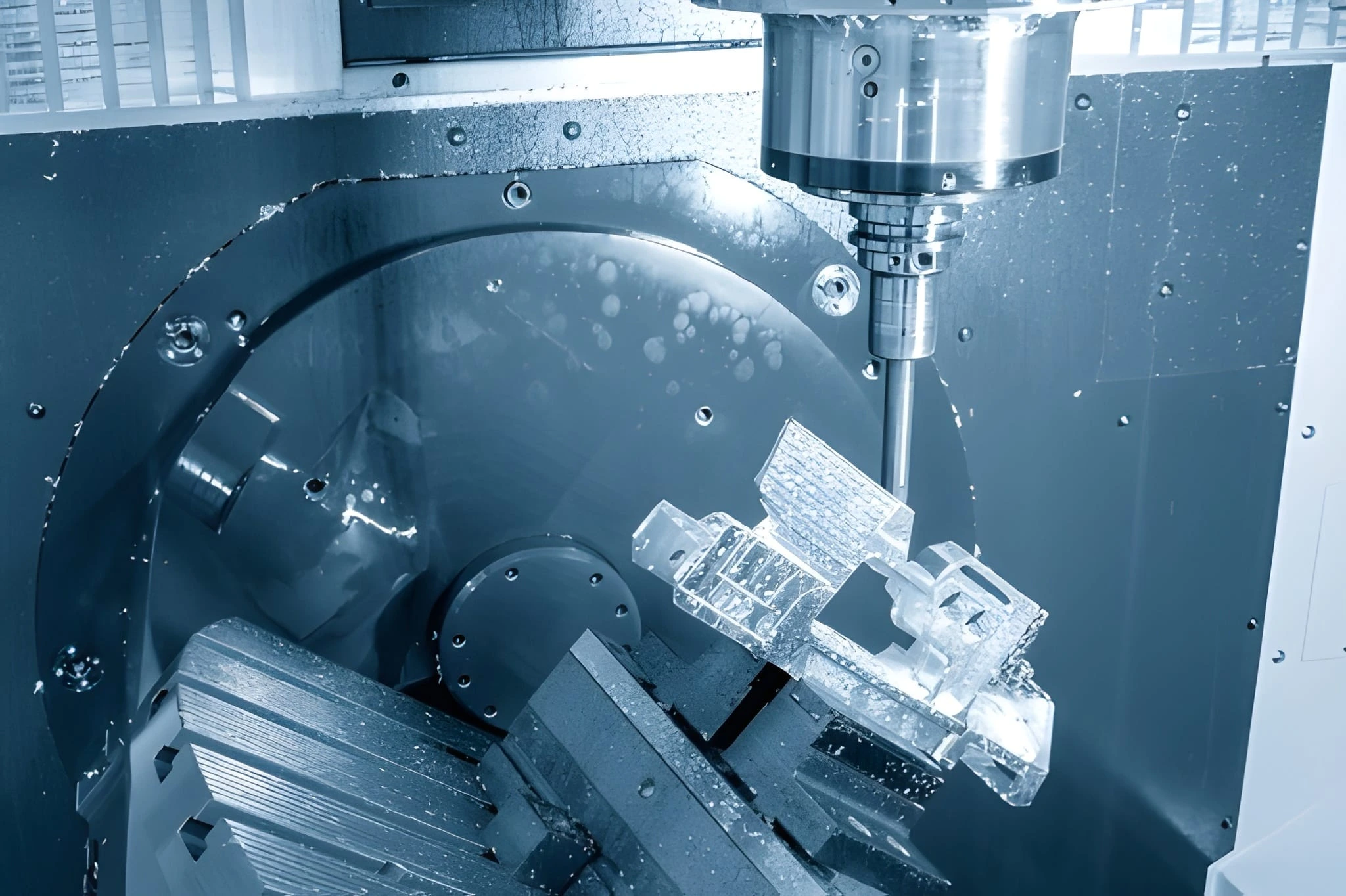
A 5-axis CNC machining system combines three linear axes (X, Y, Z) with two rotational axes (A and B) to achieve a full range of simultaneous movement across the workpiece.
Left ↔ Right
Linear motion along the horizontal plane
Front ↔ Back
Linear motion — depth of the machine table
Up ↔ Down
Vertical motion — spindle height control
Rotates Around X-axis
Tilts the workpiece or spindle — enables angled cuts on front/back faces
Rotates Around Y-axis
Tilts the workpiece or spindle — enables angled cuts on left/right faces
Rotates Around Z-axis
Optional 6th axis — rotates table horizontally for full multi-face access
How the Process Works
A 3D CAD model of the part is fed into CAM software (such as Mastercam or Siemens NX), which generates precise G-code toolpaths telling the machine how to move all five axes in coordination. The raw workpiece — aluminium, titanium, steel or plastic — is mounted on the machine table. During machining, the cutting tool moves along X, Y and Z while the rotational A and B axes tilt or rotate the part, enabling cutting of intricate features and undercuts in a single setup — the "done-in-one" machining principle that removes the need for multiple fixturing operations.
2Types of 5-Axis CNC Machines
By Configuration
Trunnion-Style
A rotary table moves the workpiece around two rotational axes (A and C) while the spindle handles X, Y, Z. Excellent for high-precision simultaneous milling — used for aerospace brackets, turbine blades and medical implants.
Swivel-Rotate (Head/Table)
The spindle head moves along two rotational axes; the table moves along one linear axis. Ideal for multi-axis machining of contoured surfaces and 3D shapes requiring precision and smooth finishes.
Head/Head Style
Both rotary axes on the spindle head — providing a wide range of cutting tool motion without repositioning the workpiece. Improves accuracy and reduces setup time for aerospace and medical device components.
Double Rotary Table
Two rotary axes — a main table plus an additional rotary axis mounted on top. Perfect for simultaneous 5-axis machining and multi-sided part production in CNC machine shops handling intricate parts.
By Machining Process
Indexed (3+2) Machining
The machine positions the tool or workpiece at a fixed angle and locks it before cutting. Excellent accuracy for multi-face machining where full simultaneous movement is not required — a cost-effective first step up from 3-axis.
Continuous 5-Axis Machining
All five axes move simultaneously in real time. Creates complex geometries, organic curves and smooth surface finishes in a single setup — the highest capability configuration, ideal for aerospace and automotive components.
Mill-Turn Machining
Combines CNC milling and CNC turning in one system using live tooling that can rotate and move linearly. Performs both cutting and turning on the same workpiece — reducing cycle time and improving precision for complex custom metal parts.
3Materials Used in 5-Axis CNC Machining
5-axis CNC machining can work with a very wide range of materials — from light metals and engineering plastics to advanced composites and ceramics. The right material choice depends on required strength, heat resistance, weight and surface finish requirements.
Metals
Aluminium
Lightweight, strong and highly machinable — ideal for aerospace parts, automotive components and rapid prototyping where speed and light weight are both priorities.
Stainless Steel
High strength and corrosion resistance — used in medical devices and industrial equipment. Requires slower cutting speeds and rigid tool setups.
Titanium
Top choice for aerospace and medical machining — exceptional strength-to-weight ratio, biocompatibility and heat resistance. Demanding to machine, requiring optimised toolpaths.
Inconel & Superalloys
Heat-resistant materials for turbine components, defence systems and energy applications. 5-axis capability is essential for the complex geometries of turbine blades and housings in these alloys.
Brass / Copper / Zinc
Soft metals machined for electrical components, connectors and decorative hardware — excellent machinability allows high feed rates and very smooth finishes.
Plastics
PEEK
High-performance plastic with excellent chemical resistance and heat stability — used in medical, aerospace and energy industries for demanding structural components.
Polycarbonate / ABS / Nylon
Engineering plastics for protective housings, gears, bushings and functional prototypes — balance of strength, flexibility and machinability for a wide range of applications.
Acrylic (PMMA)
Optical clarity and easy machinability — used for lenses, displays and transparent covers where precise geometry and smooth surface finish are essential.
Composites & Advanced
CFRP (Carbon Fibre)
Extremely strong yet lightweight — automotive, aerospace and sports equipment. Requires diamond-coated tooling and dust extraction; 5-axis paths minimise delamination risk.
GFRP / Ceramics / Graphite
Glass fibre for marine and structural panels; ceramics for medical and aerospace insulation; graphite for EDM electrodes and heat management systems.
4Key Advantages of 5-Axis CNC Machining
Increased Accuracy and Precision
Fewer setups means less manual repositioning — which is the biggest source of dimensional error. Parts achieve tighter tolerances and better repeatability, critical for aerospace components, medical implants and high-precision mechanical parts.
Complex Part Production
Five-axis simultaneous movement creates complex shapes, curved surfaces and freeform designs that are impossible on a standard 3-axis machine — enabling parts to be produced as one solid piece rather than as assemblies.
Reduced Setup and Cycle Times
5-axis machines work on multiple faces of a part in one go — eliminating re-fixturing steps, reducing handling errors and accelerating overall production throughput, especially for complex parts that would otherwise require 3–5 setups on a 3-axis machine.
Improved Surface Finish
The cutting tool maintains the optimal angle to the workpiece throughout the cut — producing smoother, more uniform surfaces with minimal tool marks. Secondary polishing or grinding operations are often eliminated entirely.
Longer Tool Life
Maintaining the cutting tool at the optimal angle reduces stress and heat build-up on the tool tip — extending tool life significantly, especially when machining hard materials like titanium or Inconel where tool wear is the primary cost driver.
Greater Design Flexibility
5-axis machining empowers engineers to design parts as they need to perform rather than as the machine can cut — complex organic shapes, undercuts, deep pockets and multi-plane features are all achievable in a single operation.
Increased Efficiency
Faster cycles, fewer setups and optimised tool paths combine to make 5-axis CNC machining highly productive — cost-effective for both low-volume precision prototypes and high-volume production runs of complex components.
Versatility Across Materials and Industries
5-axis machines work across aluminium, steel, titanium, plastics and composites — serving aerospace, medical devices, automotive, energy and industrial manufacturing wherever accuracy and reliability are the priority.
5Applications and Industries
| Industry | Typical Applications | Key Advantages Used |
|---|---|---|
| Aerospace & Defence | Engine blades, turbine housings, structural brackets, missile housings, submarine parts | Tight tolerances, heat-resistant materials, single-setup precision |
| Automotive | Engine blocks, transmission components, body panel prototypes, racing vehicle parts | Complex geometries, rapid prototyping, lightweight structures |
| Medical | Hip/knee implants, surgical instruments, custom medical devices, dental prosthetics | Biocompatible materials, accuracy, strict quality compliance |
| Energy | Turbine blades, pump impellers, oil & gas equipment, solar mount structures | Hard material machining (Inconel, titanium), durability in harsh environments |
| Industrial Manufacturing | Impellers, gearboxes, hydraulic components, pump housings, excavator parts | Strength, repeatability, consistency across high-volume production |
| Mould & Die | Injection moulds, die-cast tooling, forging dies, extrusion tooling | Smooth surface finish, reduced polishing time, faster tooling cycles |
| Space & Satellite | Antenna arrays, satellite panels, thrusters, spacecraft housings | Lightweight design, high strength, exceptional dimensional accuracy |
63-Axis vs 5-Axis CNC Machining
| Feature | 3-Axis CNC Machining | 5-Axis CNC Machining |
|---|---|---|
| Axes of Motion | X, Y, Z (linear only) | X, Y, Z + A & B (rotational) |
| Part Complexity | Simple shapes, flat surfaces, holes | Complex geometries, contours, undercuts |
| Setup Time | Multiple setups needed for multi-sided parts | Single setup — "done-in-one" machining |
| Accuracy & Tolerances | Moderate — cumulative error across setups | High precision, tight tolerances, less human error |
| Surface Finish | May require secondary polishing operations | Smooth, uniform finish from optimised tool angle |
| Tool Life | Standard — tool angle not optimised | Extended — optimal cutting angle reduces tool stress |
| Programming | Easier to program — simpler toolpaths | Requires advanced CAM software and skilled programmer |
| Material Versatility | Metals, plastics | Metals, composites, ceramics, advanced materials |
| Typical Industries | General manufacturing, fixtures, simple tooling | Aerospace, medical, defence, automotive, energy |
| Cost | Lower upfront investment | Higher initial cost but greater efficiency and quality at scale |
7When Does 5-Axis Machining Make Sense?
✅ Use 5-Axis When:
- The part has complex geometries on multiple planes — steep contours, organic curves or undercuts unreachable with 3-axis
- Single-setup machining is desired — eliminate re-fixturing errors and ensure dimensional consistency across all faces
- High precision and accuracy are critical — aerospace, medical and defence parts with mandatory tight tolerance compliance
- Production time and labour costs need reduction — machining all surfaces in one setup increases throughput
- Superior surface finish is required — the machine maintains optimal tool angle, producing smooth finishes with minimal secondary operations
❌ Avoid 5-Axis When:
- The part is simple — flat surfaces or basic geometries work better and more cheaply on 3-axis machines
- Cost is the primary concern — 5-axis machines, advanced tooling and CAM programming are more expensive
- Complexity doesn't require it — never use 5-axis just because it's available; choose the most efficient method that meets the requirements
8Can 5-Axis Machining Provide Tight Tolerances?
Yes — 5-axis CNC machining is highly capable of achieving tight tolerances, often exceeding the accuracy of conventional 3-axis machining. The ability to machine complex geometries in a single setup minimises repositioning and reduces human error, resulting in high-precision components.
- Fewer setups: Five-axis movement accesses multiple sides without repositioning — minimising setup errors and ensuring consistent dimensional accuracy across the entire part
- Complex shapes without compromise: Intricate surfaces, steep contours and organic geometries can be held to the same tolerance as simple features — no compromise for complex geometry
- Optimal tool angle: The cutting tool maintains the best cutting angle throughout — producing smooth, uniform surfaces and consistently achieving design tolerances
- Reduced human error: Automation and multi-axis simultaneous movement limit the variability introduced by manual handling — ensuring precise and repeatable results across production runs
9Limitations and Challenges
- High initial investment: 5-axis machines cost significantly more than standard 3-axis machines — upfront capital investment is substantially higher and must be justified by production volume and complexity
- Complex maintenance: Additional axes and moving components increase the need for regular calibration, monitoring and skilled maintenance compared to simpler CNC equipment
- Specialised tooling: Certain materials or geometries require expensive custom tooling — adding to operational costs that must be amortised over production volume
- Advanced CAM programming: Skilled CAM programmers are needed to coordinate all five axes simultaneously, optimise toolpaths, and prevent tool collisions — a specialist skill set not universally available
- Longer setup time: Preparing a 5-axis machine for production takes longer than for 3-axis due to complex toolpath verification and workpiece positioning requirements
- Skilled workforce: Operators and programmers need advanced training in multi-axis movement, CAD/CAM software, workholding and collision avoidance — raising labour costs
- Collision risk: The flexibility of 5-axis movement increases the risk of tool or spindle collisions — making simulation and virtual verification essential before running on the machine
- Workpiece fixturing: Securing parts on a rotating table or multi-axis fixture can be challenging — poor fixturing affects accuracy, surface quality and can cause vibration that degrades tool life
10Choosing the Right 5-Axis CNC Machining Service Provider
Selecting the right partner is critical to ensure high-quality, precise and efficient production. A reliable provider handles complex geometries, tight tolerances and diverse materials while delivering on time and on budget.
Expertise and Experience
Proven track record in high-precision multi-axis machining. Material proficiency across metals, plastics, composites and ceramics. Expert knowledge of CAD/CAM software (SolidWorks, Mastercam, Siemens NX, CATIA).
Equipment and Technology
State-of-the-art 5-axis CNC machines capable of handling intricate parts at required tolerances. Technical capability to adapt to your project's specific geometry, material and precision requirements.
Quality Control and Certifications
Rigorous quality assurance including CMM inspection for precise dimensional verification. Industry certifications — ISO 9001 for general manufacturing or AS9100D for aerospace — indicate consistent standards compliance.
Communication and Project Management
Clear, responsive communication throughout the project. Proactive technical guidance and transparency — not a "black box" production approach. You should always know where your parts are in the process.
Scalability — Prototype to Production
The right partner scales with your needs — from rapid prototyping of first articles to full-scale production runs. Confirm their ability to meet deadlines without compromising accuracy or quality as volume increases.
Reputation, Cost and Total Value
Customer reviews and referrals indicate reliability and client satisfaction. Evaluate total cost of ownership including tooling, inspection and post-processing — not just the initial per-part price. The cheapest quote rarely delivers the best result for complex precision parts.
Conclusion
Audhe Industries stands at the forefront of precision manufacturing, offering top-tier 5-axis CNC machining services tailored to meet diverse industrial needs. Our commitment to advanced technology, skilled craftsmanship and stringent quality standards ensures accurate, efficient and reliable machining solutions.
Whether it's complex components with organic geometry, tight-tolerance precision parts, or high-precision prototypes for automotive, aerospace or medical applications, Audhe Industries delivers excellence every time — making us your trusted partner in innovative and precise manufacturing.
?Frequently Asked Questions
What is 5-axis CNC machining and how does it work?
What are the benefits of using 5-axis CNC machining services?
Why choose Audhe Industries for 5-axis CNC machining services?
What makes 5-axis CNC machining ideal for complex parts?
Can 5-axis CNC machining be used for prototyping and production?
Related Articles


