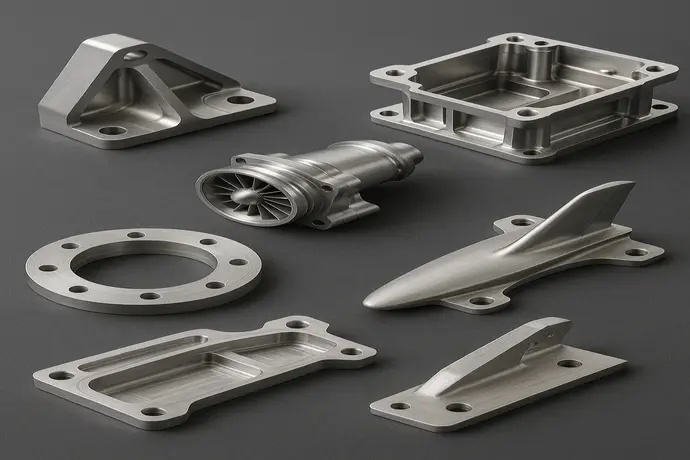
Aerospace CNC machining faces many challenges due to strict safety, quality, and performance standards. It involves hard materials, complex shapes, and tight tolerances, all under regulations like AS9100 and FAA rules. These challenges influence how aerospace components are designed, machined, and inspected.
Material and Component Challenges
Tough Materials
Aerospace parts are often made from strong, heat-resistant materials like titanium, Inconel, and nickel-based superalloys. These materials are common in high-precision CNC components but generate high cutting forces, heat, and tool wear. Special tools and machining strategies are needed to maintain accuracy and extend tool life.
Complex Geometries
Many aerospace CNC machined parts have thin walls, undercuts, curves, and tight internal features. Producing these complex shapes while maintaining surface finish and precision is difficult, especially in multi-axis machining.
Large, Thin-Walled Parts
Machining large parts with thin walls can cause vibration, stress, and warping. Removing too much material too quickly or unevenly may distort the part. This is especially risky for high-precision aerospace components, where any deformation is unacceptable.
Thermal Management
Heat buildup is a major issue when machining low-conductivity alloys like titanium and Inconel. Poor heat control can lead to thermal deformation and dimensional errors. Effective cooling strategies are essential for producing stable, accurate aerospace CNC components.
Process and Quality Challenges
Tight Tolerances
Aerospace components often require tolerances measured in microns. Achieving this level of precision requires careful process planning, high-end tooling, and advanced machines such as 5-axis CNC systems.
Strict Quality Control
Aerospace manufacturing must meet certifications like AS9100 and regulatory rules from the FAA and EASA. This involves extensive inspections, documentation, testing, and traceability for all aerospace machined components.
Programming and Human Error
Programming multi-axis CNC machines is complex. Mistakes in G-code, CAM software, or machine setup can lead to crashes, scrap, or delays. Creating reliable aerospace CNC components requires skilled operators and careful validation.
Surface Finish Requirements
Surface finish affects performance, durability, and safety. Burrs, scratches, and tool marks can cause failures in engines, landing gear, or flight-critical components. Achieving the right finish is often a challenge, especially on hard metals and composite materials.
Economic and Workforce Challenges
High Equipment Costs
Advanced CNC machines—especially multi-axis systems needed for precision aerospace CNC machining—can cost millions of dollars. The high investment makes it harder for companies to scale quickly.
Skilled Labor Shortage
There is a limited number of experienced machinists, and many are nearing retirement. Aerospace manufacturers need skilled workers to run, program, and maintain the machines that produce aerospace CNC machined parts.
Supply Chain Issues
Sourcing certified, high-quality aerospace materials can be difficult. Delays, material shortages, or inconsistencies in batches can slow production of aerospace-grade CNC components and increase costs.