
Table of Contents
- Introduction
- 1. What Are CNC Milling and Turning?
- 2. What Is CNC Milling?
- 3. What Is CNC Turning?
- 4. Milling vs Turning Compared
- 5. Equipment, Tools & Tooling
- 6. CNC Programming & Software
- 7. Quality Control & Inspection
- 8. Advantages & Disadvantages
- 9. Applications & Industries
- 10. Safety & Best Practices
- 11. Trends & Future
- FAQ
0CNC Milling & Turning — Introduction
Imagine making parts for cars, airplanes, medical devices, or electronics quickly and accurately. CNC machining makes this possible. It uses computer-controlled machines to shape metal, plastic, or composite materials into precise parts.
This guide focuses on CNC milling and CNC turning — the two most widely used CNC machining processes. You will learn the differences between these processes, how machines and tools work, the steps involved in making parts, quality checks, safety considerations, and future trends.
1What Are CNC Milling and Turning?
CNC milling and turning are two key types of computer-controlled machining. Both create precise parts from metals, plastics, or composites, but they work in fundamentally different ways.
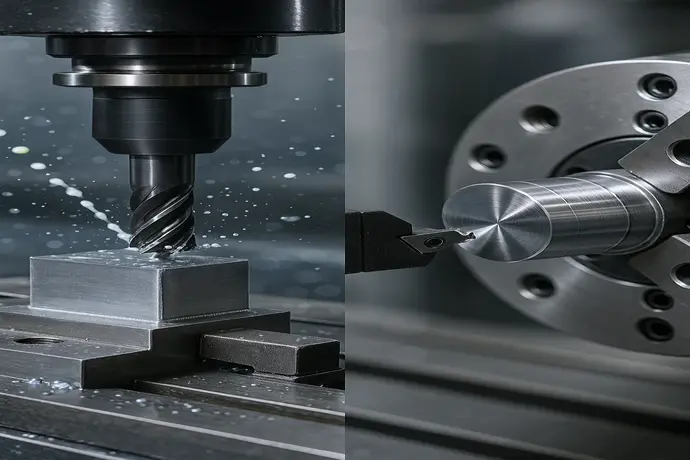
CNC Milling
- A rotating cutting tool moves along the part to remove material
- Ideal for flat surfaces, pockets and complex shapes
- Used in automotive, aerospace, medical devices and electronics
- Great for custom components and prototypes
CNC Turning
- The workpiece rotates while a stationary tool removes material
- Best for cylindrical or conical parts — shafts, pins, bushings
- Common in automotive, industrial machinery and precision engineering
- Excellent for threaded and round components
Both processes are widely used in modern manufacturing to make accurate and reliable parts. Many industries use both together to produce complete, fully finished components.
2What Is CNC Milling?
CNC milling is a precision machining process where a rotating cutting tool removes material from a stationary workpiece. It is widely used for custom machined parts, prototypes and production components.
2.1 How CNC Milling Machines Work
- The workpiece is fixed on a worktable
- A rotating cutting tool moves along multiple axes to remove material
- The machine follows a pre-programmed toolpath from CAD/CAM software
- This produces high-precision parts quickly and consistently
2.2 Key Components of a CNC Milling Machine
- Spindle: Holds and rotates the cutting tool at high speed
- Worktable: Secures the workpiece during machining
- Tool changers: Automatically switch cutting tools during operations
- Control panel: Allows operators to load programs and monitor machine functions
2.3 Types of CNC Milling Machines
| Type | Spindle Orientation | Best For |
|---|---|---|
| Vertical Milling | Vertical (top-down) | Flat surfaces, pockets, general machining |
| Horizontal Milling | Horizontal (side) | Heavier cuts, slotting, long workpieces |
| 5-Axis Milling | 5 simultaneous axes | Complex 3D shapes, aerospace parts |
| Gantry Milling | Overhead gantry | Heavy or oversized workpieces |
2.4 Common Milling Operations
- Face milling: Produces flat surfaces across the top of the workpiece
- End milling: Cuts profiles, slots, and complex shapes along the edges
- Slotting: Creates grooves or channels in a part
- Drilling: Produces holes of various sizes and depths
- Contouring: Machines curved surfaces and intricate features
2.5 Materials Suitable for CNC Milling
- Metals: Aluminium, steel, brass, titanium, stainless steel
- Plastics: ABS, PVC, polycarbonate, nylon, PEEK
- Composites: Carbon fibre, fiberglass and other reinforced materials
3What Is CNC Turning?
CNC turning is a precision machining process where a rotating workpiece is shaped using a stationary cutting tool. It is widely used for producing cylindrical, conical and threaded parts.
3.1 How CNC Lathes Work
- The workpiece is mounted in a chuck or collet
- The spindle rotates the workpiece at controlled speeds
- A stationary cutting tool removes material along the length or diameter
- CNC programming ensures consistent shapes, dimensions and finishes across multiple parts
3.2 Key Components of a CNC Turning Machine
- Chuck: Holds and rotates the workpiece securely
- Spindle: Provides rotational motion to the workpiece
- Turret: Holds multiple cutting tools for different operations
- Bed: Provides a stable foundation for the spindle and tool carriage
3.3 Types of CNC Turning Machines
- 2-axis lathes: Basic X and Z-axis control for simple cylindrical parts
- Multi-axis lathes: Additional axes for angled cuts, drilling or milling
- Swiss-type lathes: High-precision for small, intricate parts
- CNC turning centres with milling: Combine turning and milling in one setup
3.4 Common Turning Operations
- Facing: Creates a flat surface at the end of the workpiece
- Threading: Produces internal or external threads for fasteners
- Grooving: Cuts narrow slots or channels in the workpiece
- Boring: Enlarges existing holes or cylindrical internal features
- Knurling: Adds textured patterns for grip or aesthetics
3.5 Materials Suitable for CNC Turning
- Metals: Steel, aluminium, brass, titanium, stainless steel
- Plastics: ABS, nylon, polycarbonate, Delrin (Acetal)
- Exotic alloys: Nickel-based alloys, Inconel and other high-performance materials
4CNC Milling vs CNC Turning — Full Comparison
Both processes remove material to create precision parts, but they differ fundamentally in motion, geometry and best applications. Understanding these differences helps engineers and manufacturers choose the right process.
Milling = rotating tool, stationary workpiece → flat surfaces, pockets, complex 3D shapes
Turning = rotating workpiece, stationary tool → cylindrical, conical and threaded round parts
| Feature | CNC Milling | CNC Turning |
|---|---|---|
| What rotates | Cutting tool | Workpiece |
| Part shape | Flat, complex, 3D, pockets | Round, cylindrical, conical |
| Primary axes | X, Y, Z (up to 5-axis) | X and Z axes |
| Surface finish | Good; may need finishing on complex surfaces | Very smooth on cylindrical surfaces |
| Common parts | Housings, brackets, manifolds, plates | Shafts, bushings, pins, rings, fasteners |
| Best use | Complex geometries, flat/angled features | High-volume round parts, threaded components |
| Material removal rate | Moderate | High (on round stock) |
When to Use Each Process
Use CNC Milling When You Need:
- Irregular or complex 3D shapes
- Flat surfaces and pockets
- Non-cylindrical parts
- Detailed features or internal cavities
- Angled cuts and multiple face operations
Use CNC Turning When You Need:
- Round, cylindrical or conical shapes
- Smooth, even surfaces on rotating parts
- Threaded external or internal features
- Bushings, shafts, rods and rings
- High-volume identical round components
Industries Using Both Processes
- Automotive: Engine parts, brackets, bushings and custom performance components
- Aerospace & Defence: Tight-tolerance titanium and aluminium structural parts
- Medical Devices: Implants, surgical tools and precision components
- Electronics & Hardware: Metal housings, heat sinks and small connectors
- Industrial Engineering: Production parts, fixtures and prototype components
5Equipment, Tools and Tooling
Good tooling is essential for precision CNC parts. The right tool, material and workholding method ensure accuracy, surface quality and machine stability.
5.1 Cutting Tools for Milling
End Mills
Multi-point cutters used for pockets, slots and sharp edges. Excellent for detailed or complex features in metals and plastics.
Face Mills
Used to create flat surfaces rapidly. Remove material efficiently — ideal for large, smooth faces on a part.
Ball-Nose Cutters
Rounded-end tools for curved shapes, 3D surfaces and smooth contours — common in aerospace, automotive and product design.
5.2 Cutting Tools for Turning
Inserts
Small replaceable cutting tips in different shapes for roughing, finishing, or threading. Cost-effective as only the tip is replaced, not the entire tool.
Boring Bars
Enlarge holes inside a rotating workpiece — used for accurate internal diameters in shafts and housings.
Threading Tools
Cut internal or external threads on shafts, rods and other round parts to precise pitch and form.
5.3 Tool Materials
| Material | Properties | Best For |
|---|---|---|
| Carbide (WC-Co) | Very hard and heat-resistant | High-speed cutting and tough metals like steel and titanium |
| HSS (High-Speed Steel) | Flexible, less brittle than carbide | General machining and softer materials |
| Coated Tools (TiN, TiAlN) | Reduced friction and heat | Extended tool life in both milling and turning |
| Ceramic / CBN | Extreme hardness | Hard turning, hardened steels and superalloys |
5.4 Workholding Methods
Milling: Vises, Clamps and Fixtures
- Vises: Hold small to medium parts tightly for milling operations
- Clamps: Secure flat or large workpieces directly to the machine table
- Fixtures: Custom setups for complex shapes or high-repeat production jobs
Turning: Chucks and Collets
- 3-jaw chucks: Quick mounting for general round stock — standard for most turning jobs
- 4-jaw chucks: Independent jaws for off-centre or irregular workpieces
- Collets: Hold small or delicate pieces with very high accuracy and concentricity
5.5 Common Toolpath Strategies
- Facing: Clean the surface before detailed operations
- Profiling: Cut the outer shape of the part
- Pocketing: Remove material inside a closed boundary
- Drilling: Create holes at precise locations and depths
- Roughing and Finishing passes: Rough out material quickly, then finish to final tolerance
6CNC Programming & Software
CNC machining depends on accurate programming. The machine follows digital instructions to shape material and create precision parts. Good programming improves quality, reduces errors, and shortens production time.
6.1 G-Code and M-Code
G-Code — Movement Control
- Controls tool position and direction
- Sets feed rate and cutting speed
- Defines the cutting path and depth
- G2/G3 for clockwise/counterclockwise arcs
M-Code — Machine Functions
- Turn spindle on or off
- Change cutting tools (ATC)
- Control coolant flow
- Program start/stop and cycle end
6.2 CAD/CAM Software
- Fusion 360: All-in-one design, simulation and CAM — great for prototyping and small production
- SolidWorks CAM: Integrated with SolidWorks for design-for-manufacturing and easy toolpath creation
- Mastercam: Powerful CAM tool known for advanced milling and turning paths and strong cutting strategy control
6.3 Post-Processing and Simulation
After toolpaths are created, a post-processor converts them into G-code specific to the CNC machine. Before cutting real material, machinists run a simulation to check for tool collisions, wrong toolpaths and cutting errors — reducing waste and protecting tools.
6.4 Reducing Cycle Time
- Use efficient, optimised toolpaths that minimise air cutting
- Select correct cutting speeds, feeds and depths for the material
- Minimise tool changes and workpiece repositioning
- Use multi-axis moves in milling and fewer roughing passes in turning
- Combine milling and turning in one setup where possible
7Quality Control and Inspection
Quality control ensures every CNC machined part meets exact specifications. In aerospace, medical and automotive manufacturing, even tiny deviations can cause failures.
7.1 Measurement Tools
- CMM (Coordinate Measuring Machine): Uses a probe to measure complex 3D shapes with high precision — ideal for tight-tolerance components
- Calipers and Micrometers: Quick hand tools for lengths, diameters and thicknesses on round or flat parts
- Optical / Laser Measurement: Checks part geometry and alignment without touching the material — ideal for delicate or small components
7.2 Tolerances and GD&T
Tolerances define how much a part's size can vary while still functioning correctly. GD&T (Geometric Dimensioning and Tolerancing) describes shape, orientation and location tolerances on technical drawings. Proper tolerances ensure parts fit correctly, perform consistently, and meet industry standards.
7.3 Surface Roughness
- CNC turning often produces very smooth finishes on cylindrical parts because the workpiece spins evenly
- CNC milling may leave small tool marks on flat or complex surfaces — polishing or secondary operations improve finish where needed
7.4 Common Defects and Prevention
| Defect | Cause | Prevention |
|---|---|---|
| Burrs | Worn or incorrect cutting tools | Use sharp tools, correct feed rates and deburring operations |
| Tool marks / scratches | Worn tooling or incorrect feed rate | Optimised feed rates and regular tool inspection |
| Dimensional errors | Machine calibration or improper setup | Regular calibration, careful fixturing and first-article inspection |
| Chatter / vibration | Loose workholding or worn tools | Stable fixturing and optimised cutting parameters |
8Advantages and Disadvantages
Benefits of CNC Milling
- Complex shapes: Ideal for parts with flat surfaces, pockets, angled features and intricate designs
- Multi-axis capability: 3, 4 or 5-axis movement for detailed features and complex 3D geometry
- High precision: Consistent, repeatable accuracy for custom machined parts
- Versatility: Works with metals, plastics and composites
- Rapid prototyping: Excellent for both prototypes and small/medium production runs
Benefits of CNC Turning
- Ideal for round parts: Perfect for shafts, pins, bushings and cylindrical components
- Smooth surface finish: Rotating workpiece ensures even, polished surfaces
- Fast material removal: Speeds up production on round or conical parts
- High accuracy: Maintains tight tolerances on diameters and threads
- Repeatability: Excellent for producing multiple identical parts in series
Common Challenges in CNC Machining
- High initial setup costs: Machines and tooling require significant investment
- Programming skills needed: Operators must know G-code, M-code and CAD/CAM software
- Tool wear: Cutting tools wear out and must be inspected and replaced regularly
- Setup errors: Incorrect fixturing or calibration can lead to wasted material and rework
- Some material limitations: Very hard or brittle materials can be challenging to machine efficiently
Cost Considerations
- Machine type: Multi-axis machines cost more to purchase and operate
- Material: Titanium and specialty metals cost more than aluminium or mild steel
- Tooling: Quality carbide or coated tools cost more but last longer and give better results
- Volume: Higher production volume reduces cost per part as setup is amortised
9Applications and Industries
CNC milling and turning are essential in many industries because they produce high-precision parts quickly and reliably.
- Automotive: Engine components, shafts, pistons, custom brackets and performance racing parts
- Aerospace: Turbine blades and housings, aircraft fittings and structural components — all with extreme accuracy and high-quality finishes
- Medical Devices: Surgical instruments, orthopaedic implants, prosthetics and custom medical components with repeatable accuracy and smooth finishes
- Industrial Machinery: Gears, shafts, brackets, tools, fixtures and parts for automated equipment
- Consumer Electronics: Metal and plastic enclosures, heat sinks, brackets and small precise connectors
- Prototyping & Production: Rapid prototypes for design validation plus low-to-medium volume production without expensive tooling
10Safety and Best Practices
Safety is critical in CNC milling and turning. Proper practices protect operators, prevent machine damage, and ensure high-quality parts.
10.1 Machine Safety Procedures
- Always wear safety glasses, gloves and protective clothing near CNC machines
- Keep hands and loose clothing away from rotating spindles and moving parts
- Use emergency stop buttons immediately if the machine malfunctions
- Ensure proper ventilation when cutting metals that produce dust or fumes
- Only trained, authorised personnel should operate CNC machines
10.2 Proper Tool Handling
- Check that end mills, inserts and boring bars are correctly seated and tightened
- Use the correct tool grade and geometry for each material and operation
- Inspect tools for wear or chipping before each setup — never run a damaged tool
- Store tools safely in holders or racks to prevent chipping or bending
10.3 Maintenance and Calibration
- Regularly clean machines to remove chips, swarf and debris
- Lubricate guide ways and moving parts according to the manufacturer's schedule
- Check and calibrate machines periodically to maintain precision and tolerances
- Inspect workholding devices (chucks, collets, vises) for proper grip and condition
10.4 Cutting Parameter Optimisation
- Set correct spindle speed, feed rate and depth of cut based on material and tool specification
- Avoid excessive speed or feed that can cause tool breakage or workpiece damage
- Use CAM simulation to test parameters before cutting real material
- Optimise parameters to reduce chatter (vibration) and improve surface finish
11Trends and Future of CNC Milling & Turning
CNC machining is evolving rapidly. New technologies are making milling and turning faster, smarter and more precise.
- Automation and Robotics: Robots load/unload parts and run machines 24/7 — improving consistency, throughput and eliminating fatigue-related errors
- AI-Driven Toolpath Optimisation: Artificial intelligence analyses machining data to create better toolpaths, reduce cycle time, prevent tool wear and improve surface finish automatically
- Hybrid Manufacturing (CNC + Additive): Machines that combine CNC milling/turning with 3D printing allow machining and material addition in the same setup — useful for aerospace and medical prototypes
- Industry 4.0 and Smart Factories: Connected CNC machines use real-time sensors for predictive maintenance, remote monitoring and quality control — reducing downtime and improving efficiency
- Multi-Tasking Machines: Machines that combine milling and turning in one setup reduce handling, setup time and errors while producing complex parts in fewer steps
✓Conclusion
At Audhe Industries, we understand the importance of precision, efficiency and quality in manufacturing. Our CNC milling and turning services help businesses and engineers turn their ideas into high-quality, accurate parts.
Whether you need custom prototypes, small production runs, or large-scale manufacturing, we use the latest CNC machines and skilled operators to deliver reliable results. From automotive and aerospace components to medical devices and industrial machinery, we ensure every part meets tight tolerances and high standards.
?Frequently Asked Questions
What is the difference between CNC turning and milling?
What is CNC?
What is G2 G3 CNC code?
What are the 5 axes of CNC?
How many types of CNC turning are there?
What is CNC vs NC vs DNC?
Is CNC operation hard to learn?
Related Articles


