
Introduction
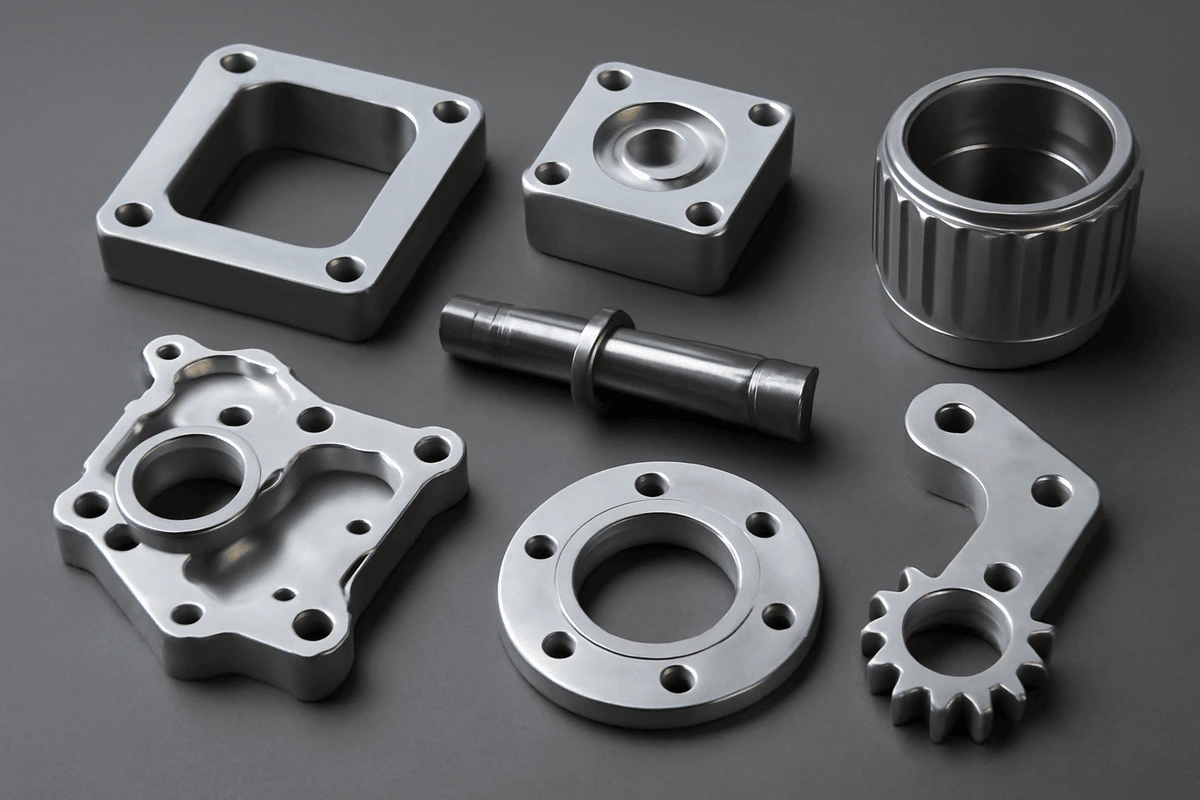
Look inside almost any machine, whether it's a car gearbox, a hydraulic pump or a textile loom, and you'll find parts that were cut to size on a CNC machine. These CNC machined components are made by computer-controlled lathes and milling machines that remove metal or plastic until the part matches its drawing, often to within a few hundredths of a millimetre.
This guide is for engineers and buyers who need to specify or source machined parts. It explains how CNC machining works, the main types of parts, which materials to choose, the tolerances you can expect, and what to check before you choose a supplier. If you already have a drawing and need a price, go straight to our CNC machining service.
What Is CNC Machining?
CNC stands for Computer Numerical Control. A program tells the machine exactly where to move the cutting tool, how fast to spin it and how deep to cut. Because the program does the work rather than an operator's hands, the hundredth part comes out the same as the first.
It's a subtractive process: you start with a solid bar, block, forging or casting and cut away everything that isn't the part. That's the opposite of 3D printing, which builds a part up layer by layer.
The two workhorse processes are CNC turning on a lathe, for round parts, and CNC milling on vertical (VMC) or horizontal (HMC) machining centres, for flat faces, pockets and holes. Simple parts are milled on 3-axis machines, while 4-axis and 5-axis machines reach several faces in one setup, which saves time and improves accuracy. Our guide to CNC milling and turning goes into more detail, and there's a broader overview in what is CNC machining.
What Are CNC Machined Components?
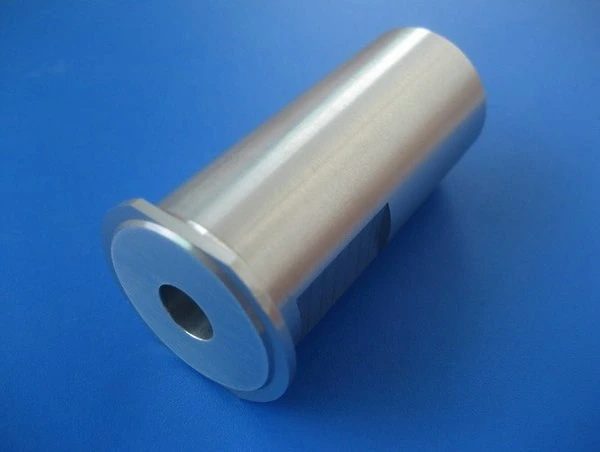
A CNC machined component is any part whose final shape, size or finish comes from CNC machining. Some are machined entirely from bar stock, like a hydraulic fitting or a shaft. Others start as a casting or forging and are machined only where accuracy matters, such as the bores and mounting faces of a pump housing.
What they all have in common is precision. A bearing seat that's a few microns too big, or a thread that's slightly off, can cause leaks, vibration or early failure. CNC machining makes it practical to hold those dimensions on every part in a batch, not just the first one.
Common examples
- Shafts, pins, bushes and spacers, usually turned
- Flanges, couplings and hydraulic fittings, turned and often given milled flats or cross-holes
- Pump and valve bodies, manifolds and gearbox housings, milled and often machined from castings
- Brackets, plates and fixtures, milled from plate or block
How Are CNC Machined Parts Made?
Every job follows the same five steps, whether it's a single prototype or a run of ten thousand.
Drawing and 3D model
It starts with your 2D drawing and, ideally, a 3D CAD model. A good supplier reviews it for manufacturability (DFM) and flags anything that will add cost without adding value, such as a tolerance tighter than the part really needs.
Programming (CAM)
CAM software turns the model into toolpaths and generates the G-code the machine follows: tool movements, spindle speed, feed rate, depth of cut and tool changes.
Machine setup
The workpiece is clamped in a vice, fixture or chuck, the cutting tools are loaded, and tool offsets are set so the machine knows exactly where each tool tip is.
Machining
The machine runs the program, turning, milling, drilling and tapping the part. Complex parts may move between a lathe and a machining centre, or go through several setups.
Inspection and finishing
Dimensions are checked with calipers, micrometers, bore gauges or a CMM. The part is then deburred and, if the drawing calls for it, heat treated, anodised, plated or powder coated.
Types of CNC Machined Components
Machined parts are usually grouped by the process that shapes them.
CNC turned components
Made on a CNC lathe or turn-mill centre, where the workpiece spins against a fixed tool. Turning suits anything round: shafts, pins, bushes, flanges, couplings, spindles and threaded fittings.
CNC milled components
Made on a machining centre, where a spinning cutter moves across a fixed workpiece. Milling suits flat faces, pockets, slots and 3D shapes: housings, manifolds, brackets, plates and gears.
Drilled and tapped parts
Holes, threads and cross-drillings are usually added on the same machining centre. Accurate hole position matters most on parts that bolt together or carry fluid, such as hydraulic blocks.
Machined castings and forgings
Many components start life as an aluminium or iron casting, or a steel forging. Machining only the critical faces, bores and threads uses far less material than cutting the whole part from solid, and usually costs less in volume.
Cut and EDM parts
Laser cutting, plasma cutting and wire EDM produce flat profiles and very fine features. Wire EDM is used especially for hardened tool steels and intricate die parts.
CNC Machine Parts and What They Do
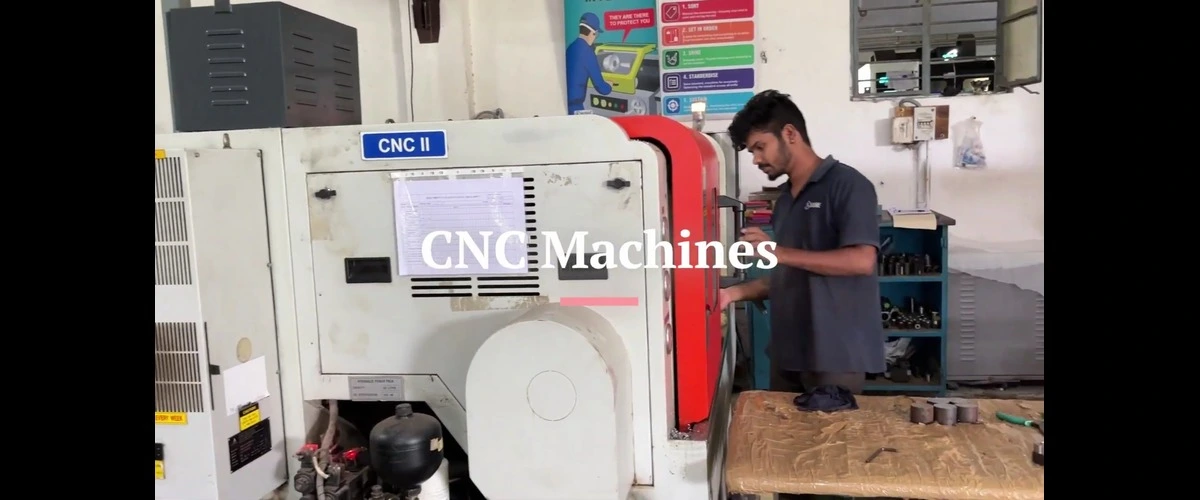
If you're new to CNC, it helps to know the main parts of the machine itself and what each one does.
| Part | What it does |
|---|---|
| Machine Control Unit (MCU) | The brain of the machine. It reads the G-code and tells the motors exactly how and when to move. |
| Control panel / display | Where the operator loads programs, sets offsets and watches the machine's status. |
| Drive system | Servo motors and ball screws that move the axes (X, Y, Z) and spin the spindle. |
| Feedback system | Encoders that report the real position back to the MCU so it can correct any error as it cuts. |
| Bed / base | The heavy frame everything sits on. Its stiffness absorbs vibration and keeps the machine accurate. |
| Spindle | Spins the cutting tool on a mill, or the workpiece on a lathe. Spindle accuracy shows up directly in part quality. |
| Table / chuck | Holds the workpiece: a table with vices or fixtures on a mill, a chuck on a lathe. |
| Tool changer / turret | Swaps cutting tools automatically, so one program can drill, mill and tap without stopping. |
| Coolant and chip systems | Cool the cut, lubricate the tool and carry chips away to keep the machine running cleanly. |
Materials for CNC Machined Components
Material choice comes down to strength, weight, corrosion resistance, machinability and cost. These are the options engineers use most.
Metals
- Aluminium (6061, 7075 and cast alloys such as LM25): light, easy to machine and widely used. 6061 is the general-purpose choice; 7075 is considerably stronger.
- Mild and alloy steels (EN8, EN24 and similar): strong and economical for shafts, gears and pins. Alloy steels can be heat treated for extra hardness.
- Stainless steel (303, 304, 316): corrosion resistant, for pumps, food machinery and marine parts. 303 machines most easily; 316 resists corrosion best.
- Brass: machines very cleanly and resists corrosion, which makes it the usual choice for fittings, bushes and fasteners.
- Copper: excellent electrical and thermal conductivity, for busbars and heat-transfer parts.
- Titanium: strong and light, but slow and costly to machine. Used where weight really matters.
- Cast iron: grey and ductile iron castings machine well and damp vibration, which is why they're used for machine bases and pump bodies.
Engineering plastics
- Acetal (POM / Delrin): stiff, stable and low friction, ideal for gears, bushes and rollers
- Nylon (PA6 / PA66): tough and self-lubricating, for wear parts
- PTFE: very low friction and chemically inert, for seals and insulators
- Polycarbonate: tough and clear, for guards and covers
- PEEK: a high-performance plastic that keeps its strength up to about 250°C
CNC Machined Parts vs Components: Is There a Difference?
In everyday use the two words mean the same thing, and buyers search for both. If you want to be precise, a part is usually a single piece, while a component can be a more complex item, sometimes made from several parts, that does a job inside a larger machine.
| Feature | Machined part | Machined component |
|---|---|---|
| Scope | A single piece | A functional unit, sometimes an assembly of parts |
| Complexity | Usually simpler, one material | Often several features, operations or materials |
| Process | Turning, milling, drilling | Machining plus assembly, testing or inspection |
| Cost and lead time | Lower and shorter | Higher and longer |
Typical components: pump housings, manifolds, spindle assemblies, valve bodies.
Why Choose CNC Machining?
1. Accuracy and repeatability
Once a program is proven, every part in the batch is cut the same way. Tolerances of ±0.01 mm are routine on modern machines, and that consistency is what makes parts interchangeable on an assembly line.
2. No tooling to wait for
There's no mould or die to make, so the first parts can be ready in days. That makes CNC machining ideal for prototypes and small batches.
3. Easy design changes
Changing a dimension means editing the program, not remaking expensive tooling.
4. Almost any material
The same machines cut aluminium, steel, stainless steel, brass and engineering plastics.
5. A finish that's ready to use
Machined surfaces are smooth and accurate enough to seal, slide or carry a bearing straight off the machine.
Industries That Use CNC Machined Components
Almost every engineering industry relies on machined parts. Some of the biggest users are:
- Automotive: engine and transmission parts, brake components, brackets and housings
- Hydraulics and pumps: fittings, valve spools, manifolds and pump shafts that have to seal under pressure
- Textile and agricultural machinery: shafts, gears, rollers and brackets for machines that run long hours
- General engineering: fixtures, spare parts and machine components of every kind
- Electrical and electronics: connectors, heat sinks, enclosures and busbars
- Oil and gas, power and renewables: valve parts, fittings and turbine hardware
- Aerospace and medical: very tight-tolerance parts, usually made under sector-specific quality systems such as AS9100 or ISO 13485
CNC Machining vs Other Manufacturing Methods
CNC machining isn't always the cheapest way to make a part. The right method depends on quantity, material and shape.
| Method | Best for | Strengths | Limitations |
|---|---|---|---|
| CNC machining from solid | Prototypes to medium volumes of precision metal and plastic parts | High accuracy, no tooling, almost any material | Cost per part stays fairly high at large volumes; more material wasted |
| Casting + CNC machining | Medium to high volumes of complex metal parts | Near-final shape saves material; machining only where it's needed | A pattern or die has to be made first |
| 3D printing | Prototypes and very low volumes | No tooling; complex internal shapes possible | Lower strength and accuracy than machining; limited materials |
| Injection moulding | High volumes of plastic parts | Very low cost per part at scale | Expensive mould; plastics only |
Tolerances and Quality Standards
Tolerance is the allowed variation from a dimension on the drawing. Tighter tolerances cost more, so it pays to specify them only where the part needs them.
- General tolerance: around ±0.1 mm is typical where nothing tighter is specified, often stated on the drawing as ISO 2768-m
- Precision features: bearing seats, bores and sealing faces are commonly held to ±0.01–0.02 mm
- Very tight work: ±0.005 mm or better is possible with grinding and careful process control, but costs significantly more
- Surface finish: Ra 1.6–3.2 µm is typical for machined faces; sealing and sliding surfaces may need Ra 0.8 µm or finer
How good suppliers control quality
- Calibrated instruments, plus a CMM for complex parts
- First article inspection before the full batch runs
- In-process checks, not just a final inspection
- An ISO 9001 quality system with traceable records
- A dimensional report with each delivery
What to Include in Your RFQ
The more complete your request, the faster and more accurate the quote. Include these details:
| Item | What to provide |
|---|---|
| Drawing and 3D model | 2D drawing (PDF or DWG) plus a 3D file (STEP, IGES or native SolidWorks) |
| Material | Grade and any heat treatment, for example EN8, SS 304 or Al 6061-T6 |
| Tolerances | General tolerance, with critical dimensions clearly marked |
| Threads | Standard (ISO metric, UNC or BSP) and thread class |
| Surface finish | Ra value and any coating: anodising, plating or powder coating |
| Quantity | Prototype quantity, first batch size and expected annual volume |
| Inspection | Dimensional report, first article inspection, material certificate or PPAP if needed |
| Delivery | Required date, packing requirements and destination |
Sourcing CNC Machined Components in India
India has become a major source of precision machined parts for both domestic OEMs and overseas buyers. Engineering clusters such as Coimbatore, Chennai, Hosur and Bengaluru have deep CNC turning and VMC capacity, skilled machinists, and foundries, forge shops and heat treaters close by. For buyers abroad, outsourcing CNC machining to India offers competitive costs with quality systems that meet international standards.
What to look for in a CNC machining supplier
- Machining to your drawing: they should quote from your drawing and 3D model and confirm which tolerances they can hold
- Inspection and certification: ISO 9001 certification, calibrated gauges or a CMM, and a dimensional report with each batch
- A range of volumes: prototypes, small batches and production runs without having to change supplier
- The right materials and processes: real experience with your material and the right mix of turning, milling and finishing
- Casting and machining under one roof: when a part starts as a casting, a supplier who both casts and machines it removes a handover and a common cause of delays
- Export readiness: for overseas orders, check packing standards, documentation and on-time delivery record
Conclusion
CNC machined components are found wherever precision matters. Getting them right comes down to a clear drawing, sensible tolerances, the right material and a supplier who inspects what they make.
At Audhe Industries in Coimbatore, we machine parts to customer drawings, from single prototypes to production batches, including aluminium castings poured in our own foundry and finished on our CNC machines. Most of our customers are in the automotive, hydraulic, textile and general engineering sectors, in India and overseas.
Frequently Asked Questions
Related Articles


